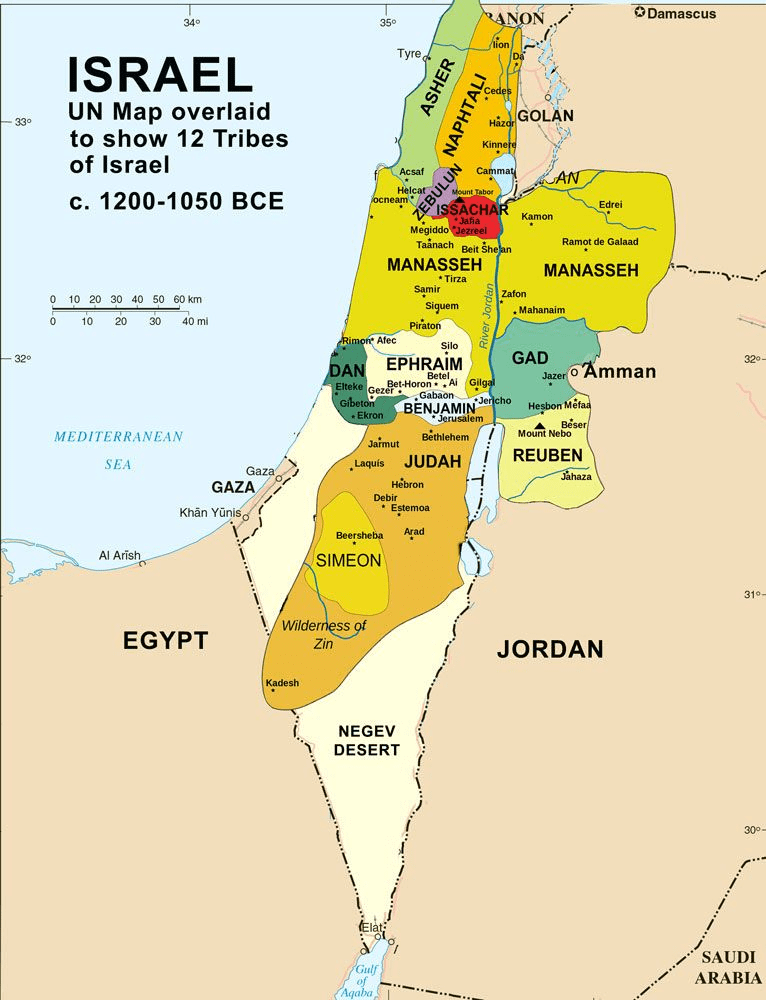
The brutal conflict between Israel and Palestine has brought forth a lot of questions regarding statehood and territory in the Middle-East. I have no interest in offering commentary on the conflict, but anyone who has studied or practiced Christianity, Judaism, or Islam knows that Israel is a special place. In the Christian Bible, it is mentioned 2,431 times and God made four eternal covenants with the Israelites, among a multitude of other promises and prophecies. Clearly, God has a great love “His people,” the Israelites.
However, in the modern age, we face a lot of uncertainty for who exactly Israel is. Is it the geo-political state established in 1948? Or is it the millions of Jews scattered around the world who can trace their lineage back to their Israeli ancestors? Maybe, it’s those who follow Jesus?
Theologians of all denominations of multiple religions have long argued over who actually is included in the religious “Israel.” And this isn’t just a modern debate, it’s been discussed among Christians for nearly two thousand years.
Geographical History of Israel
To understand every perspective, we first need to understand what the historical borders of Israel have been. Interestingly, no known maps of the ancient Kingdom of Israel actually exist, so historians and theologists have had to pull from Scripture and historical documents to try and construct a map. The best available estimation is that ancient Israel encompassed parts of modern-day Palestine (notably, not the Gaza Strip though), Jordan, Syria, Lebanon and Egypt.
For most of its history, Israel has had changing borders. In 720 BC, the Assyrians destroyed the kingdom of Israel and took them as captives. Again, in 567 BC, the Babylonians invaded Judah and destroyed Solomon’s Temple to take the Israelites into captivity again. Finally, in 70 AD the Romans completely destroyed the city, along with Solomon’s Temple. From that point on, Israel as a state ceased to exist. Under Roman rule, Jews were prohibited from entering Jerusalem and until 1948, no Jewish government existed in Israel or Palestine.
From that point, the land was controlled by Arabs (including Muslims and early Christians) and Turks, outside of brief periods of control from European Crusaders. The Jewish population fluctuated depending on the tolerance of the ruling regime.
The Three Different Perspectives
So that brings us to today. It’s been nearly 2000 years since the Kingdom of Israel was destroyed by Rome and the political borders of the region are radically different from the time Scripture was written. To answer the question of “Who is Israel?”, there are three common yet distinct perspectives:
- Dispensational/Zionist: probably the most common view among US evangelicals and certain Jewish denominations (though this may be changing). The Dispensationalist view asserts that God deals with mankind in “dispensations,” mainly innocence, conscience, human government, Abrahamic promise, Mosaic Law, grace, and the millennium which is followed by the eternal state. Thus, the Jewish descendents of Israel today are still God’s chosen people, as Israel and the church must be distinct dispensations. Naturally, this leads to Christian Zionism, the belief that Israel must be established as a Jewish state.
- Replacement/Supersessionism: a relatively uncommon view today, though it is gaining a renewed popularity. Interestingly, this was the view of the early church and for most of the history of Christianity. Old school Calvinists, Catholics, and Orthodox believed that the Church completely replaced the Jewish people as God’s people. In this interpretation, the people of God in the Old Testament believed in the coming Messiah while in the New Testament they believed in Jesus of Nazareth as the Messiah (Luke 22:37; 24:25–27). Therefore, the church is spiritual Israel, the sacrifice is Jesus Christ, the priesthood is for all believers, the temple is the hearts of believers, and the Promised Land is the Kingdom of God; there is no future role for the Jews and all Old Testament expectations are fulfilled in the church.
- Covenantal: held by most non-Evangelical Protestants and the modern Catholic Church, this view establishes both the state of Israel (once reconciled to Christ) and the Church make one people of God; one “Israel.” This is explained by 5 key points: 1) the oneness of God demands one people 2) the people of God are His by divine election and spiritual birth. 3) The people of God arise from the supporting root of historic Israel 4) the marker of the people is the internal presence of the Holy Spirit 5) the people of God are the body of Christ.
The Troubling Rise of Antisemitism Among American Evangelicals
Now I come to what led me to write this article. As mentioned earlier, there is a growing contingent of US Christians who view Israel in an antagonistic way. Influencers like Tucker Carlson and Candace Owens have taken a strong stance against Israel and unfortunately, Judaism as a whole. With influencers of their status, it’s no surprise there has been an increase in anti-semetic rhetoric among young conservatives. According to Pew Research, conservatives under 50 have an increasingly negative view of Israel.
Less visible influencers, like Nick Fuentes (a self-proclaimed Catholic-Taliban and white supremacist), have even gone as far to advocate the systematic deportation of Jewish people as he feels “they have no place in Western civilization.” Regrettably, the audience of all these influencers is mostly those who identify as Christian.
So as Christians, where do we need to stand in this complicated, messy debate? Regardless on your perspective on Israel, we should first approach this situation with love (1 Cor 16:14). By rejecting antisemitism, we show love to our Jewish neighbors, possibly leading them to Christ. We also need to love our fellow Christians regardless of their views on Israel. For decades, Christians have bickered over our eschatology (or end-time views), leading to rifts that have allowed cold-hearted antisemitism seep into our churches (Prov 6:16-19).
Second, we need to reaffirm our trust in God’s sovereignty. A lot of the same criticisms of Critical Race Theory can be levied against antisemitic claims. False assertions of Jewish conspiracies and oppression have led to calls for vengeance and reparations from extremist right-wing and left-wing thinkers. However, as Christians, we cannot ask or partake in these things; don’t fall into the trap of antisemitism. Scripture commands “Love your enemies and pray for those who persecute you” (Matthew 5:44) and says to pray, “Forgive us our debts, as we also have forgiven our debtors” (Matthew 6:12).
Finally, we need to pray. Pray that we can stay strong in times of tension and confusion, so that we aren’t deceived into believing a false gospel (Gal 1:8-9). Pray that our leaders and neighbors, Jewish, extremist, atheist, or otherwise, would come to know Jesus (1 Tim 2:1-4). And pray for Christians who are persecuted and generally in danger in Israel and Palestine (1 Peter 4:12-14).
 Faith, Food and Pharmacy